First, what is the forex market?
The foreign exchange market is where currencies are exchanged. Prices are commonly quoted in pairs, such as EUR/USD or GBP/JPY, because one currency is always valued relative to another.
Currency prices can react to interest-rate expectations, inflation, employment data, central-bank announcements, political developments and changes in global risk appetite. Because these influences overlap, forex research often involves combining several kinds of information rather than relying on a single chart or headline.
Where AI fits into market research
AI is most useful as a research assistant. It can process large amounts of structured and unstructured information quickly, helping a person identify areas that deserve closer examination.
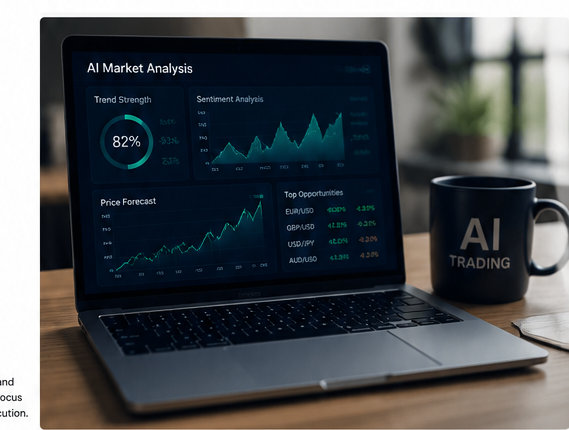
A practical research workflow
A careful process usually begins with a question, not a prediction. For example: “How has this currency pair historically reacted when interest-rate expectations changed?” AI can then help collect relevant material, but each step should be checked.
What AI cannot reliably do
AI cannot remove uncertainty from financial markets. A model may discover a historical relationship that later disappears, mistake correlation for causation or produce an answer based on incomplete information.
Language models can also generate incorrect facts, outdated explanations or confident-sounding conclusions that are not supported by evidence. For that reason, important claims should be traced back to primary sources whenever possible.
A simple checklist before trusting an AI-assisted conclusion
The bottom line
AI can make forex research faster and more organized, especially when reviewing large datasets or summarizing complex information. Its best role is to support human analysis—not replace skepticism, financial education or sound risk management.